Reimagining A Civic Landmark

Case Studies

How Finlay Park’s redesign rekindled a community’s heart

By Todd Martin (City of Columbia, SC), Mark Johnson (Civitas), and Jenny Horne (Stantec); originally published in the June 2026 issue of PRB+ Magazine.

Designing urban parks typically does not start from scratch. More often, designers inherit not only complex sites and aging infrastructure, but also sites and spaces deeply rooted in city and community history.

Finlay Park in Columbia, S.C., exemplifies this—shaped by more than 170 years of physical transformation and community attachment. A 2025 renovation built on this history through a careful redesign that balanced preservation with function, history with modern use, and design legacy with contemporary urban life and park design.

Originally opened in the mid-19th century as Sidney Park, the hillside site overlooking the Congaree River was sold to the Seaboard Air Line Railroad and flattened for industrial use before being reclaimed as public space in the late 20th century. When the park reopened in 1990, landscape architect Robert Marvin—working alongside Mayor Kirk Finlay and other civic leaders—introduced a design that was notably adventurous for its time. Rather than treating the steep hillside as a backdrop, Marvin activated it, creating a sequence of walls, water features, and elevated experiences that challenged conventional park typologies and typical design practices of the time.

That ambition became both the park’s identity and its challenge. Many elements were hand-built and engineered in the field. Over time, steep slopes sagged, soil shifted, and water systems deteriorated. As a result, park programs declined, visibility into and within the park suffered, and the park’s physical complexity began to work against its everyday functionality.

When the current redesign efforts began, the question was not whether Finlay Park needed to change, but how to change the park while preserving some of its original legacy.
Park Design As Interpretation, Not Replacement

From the outset, the project design team—consisting of Stantec, Civitas, LS3P, Chao and Associates. BGA, Johnson & King Engineers, F&ME, Aiken Cost Estimators, and the City of Columbia—approached Finlay Park as a reinterpretation rather than a complete reset. Extensive community engagement, led by both the project team and the city, informed a set of strategic goals that addressed accessibility, safety, visibility, connectivity, and community activities; key to these sessions was a resounding sentiment on updating the park without abandoning its defining character.

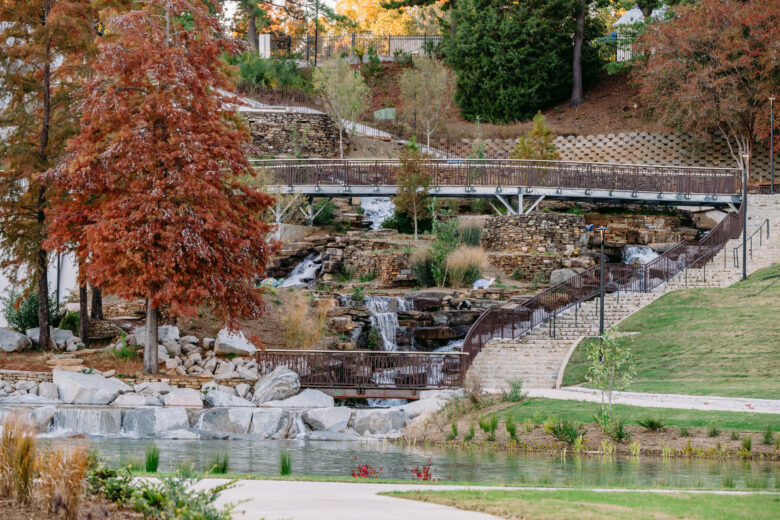
One of the most consequential design challenges was topography. With nearly 80 feet of elevation change across the site, improving accessibility required moving beyond conventional switchback ramp solutions. Instead, the redesign introduced gently sloped circulating paths, scenic overlooks, plazas, and experiential routes that transform movement within the park itself into a design feature. Visitors do not simply traverse the park; they experience it vertically, visually, and sequentially. Approaching the design of the park’s topography in this manner allows visitors to experience the park without any vertical barriers—and users of all abilities can engage with the park’s topography rather than bypass it. A signature feature is the 235 linear-foot, 9 foot-wide cantilevered pedestrian bridge suspended 30 feet above the grotto. The bridge carries visitors behind the waterfall and across active rapids—offering a thrilling, fully ADA-accessible experience.

This approach aligns with a core design concept described by the team as “three-dimensional triangulation,” the idea that from any point in the park, visitors can see multiple destinations, activities, and people using the space. This visual connectivity encourages movement, reinforces a sense of safety, and allows the park to remain easy to navigate without signage or instruction. Triangulation supports a park that is legible at a glance, reducing dead zones and distributing activity throughout the site rather than concentrating it in a single area. That philosophy extends most clearly to Finlay Park’s destination playground.

Designing An Intuitive Park

Built onto the hillside and fully accessible at multiple elevations, the destination playground promotes unstructured play rather than standard playground programming. Logs, slides, climbing elements, and turf slopes invite children to explore rather than to follow along.

The result is a space that feels intuitive to children and adults alike. As designers often say, the most successful parks are those that “need no instructions.” The immediate popularity of the hillside turf slide underscores the power of designing with curiosity in mind rather than standard park design practices and traditional use.

Fostering Safety Through Intentional Design

As the park aged, it began to suffer from limited sightlines, dense plantings, and fragmented spaces that contributed to a perception of insecurity, and made the park feel unsafe to many within the community. The design team addressed this through a thoughtful and careful update to the park’s visibility and lighting. Selective vegetation clearing opened views both into and across the park, while reshaped slopes improved visual continuity between spaces.

The park design introduced a new approach to lighting. Rather than over-illuminating paths and walkways, which can create glare and visual blind spots at night, the team integrated lighting into landscape edges, surrounding spaces, and architectural elements. This layered strategy reveals previously hidden areas, reinforces shared visibility, and establishes a cohesive, dramatic nighttime identity for the park.

This design approach is supported by onsite rangers, call boxes, cameras, and consistent programming—reinforcing safety through visibility, activity, and presence rather than exclusion.

Water As Structure And Memory

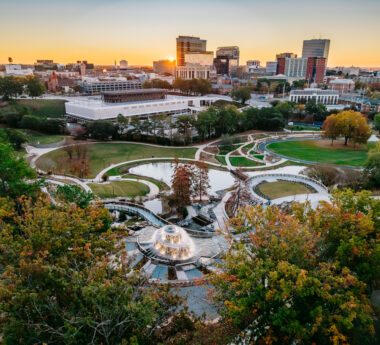
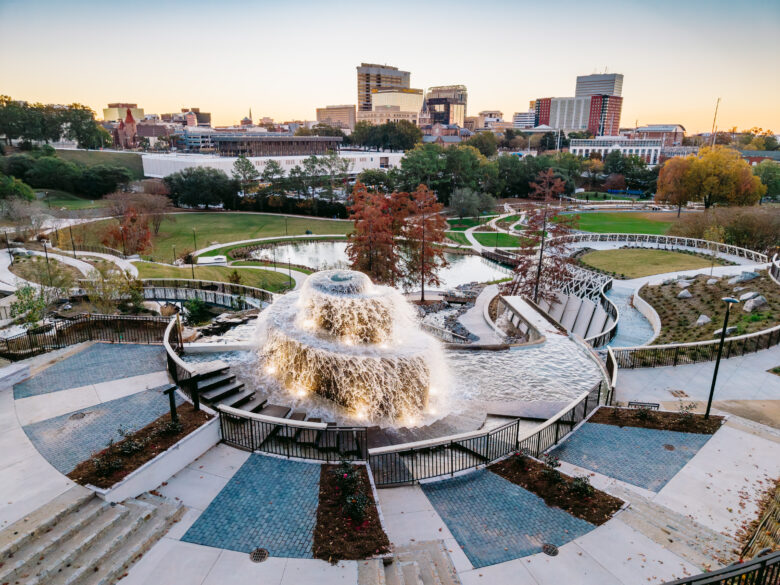
Throughout the park’s history, people’s life experiences have centered on the water features. The spiral fountain, waterfalls, rapids, and the pond were deeply embedded in community memory, serving as backdrops for weddings, photographs, and everyday moments. While removing them would have simplified maintenance and design efforts, the city and design team were committed to keeping these features as memorable pieces of the revitalized park that can evoke nostalgia and create new memories for generations to come.


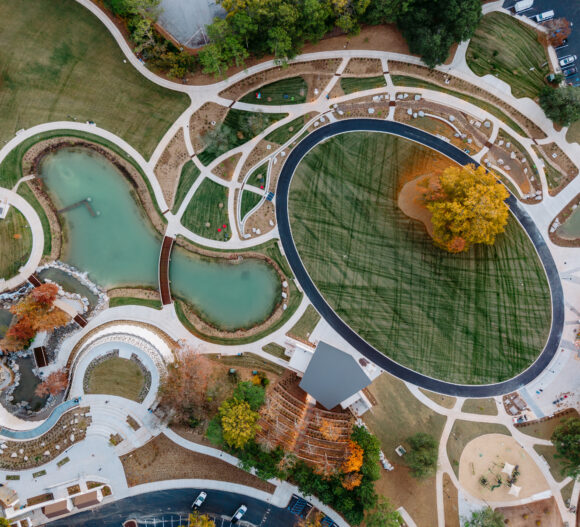
The updated water system retains the original vision while reducing leakage, improving circulation, incorporating green infrastructure, and extending the lifecycle of one of the park’s most historically significant features. Water flows from the upper spiral fountain into pools, over a dramatic precast waterfall, through rapids and grotto spaces, and into a reshaped pond that also captures and treats storm water. The feature continues from the pond in a series of runnels that flow into a new stream anchoring the strolling gardens. The feature finale is a rain garden where water is filtered and recycled to supply the entire feature in a closed-loop system. Portions of the pond were reduced to improve circulation and create a more cohesive central green and lawn space, but water remains a defining element and core identity of the park. Additionally, the design team added a pedestrian bridge across the largest pond to improve walkability and connectivity.

Architecture, Art, And Activation

In the center of the refreshed park sits a new oval greenspace and a relocated stage for concerts and large community gatherings. Oriented into the hillside, the new stage and amphitheater enhance acoustics while buffering surrounding neighborhoods—improving upon the previous design, which funneled sound into the surrounding areas and homes. Now, the stage directs sound into the heart of downtown. These changes allow the park to further integrate into the community without any of the disruptions associated with the previous design.

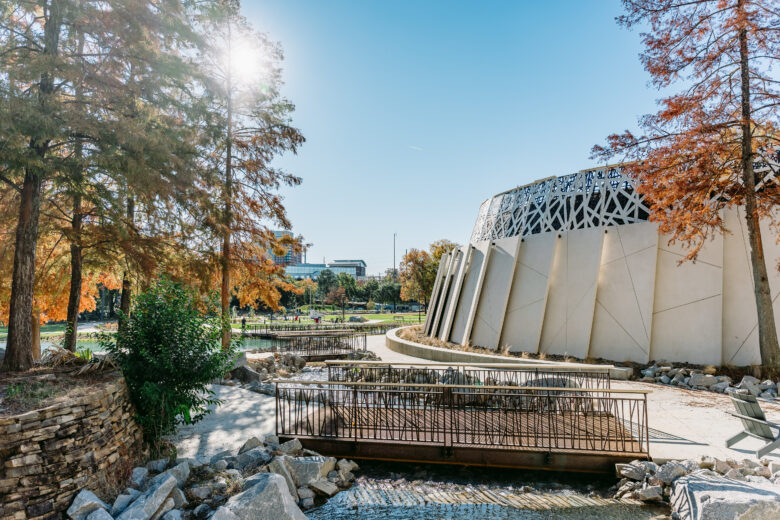
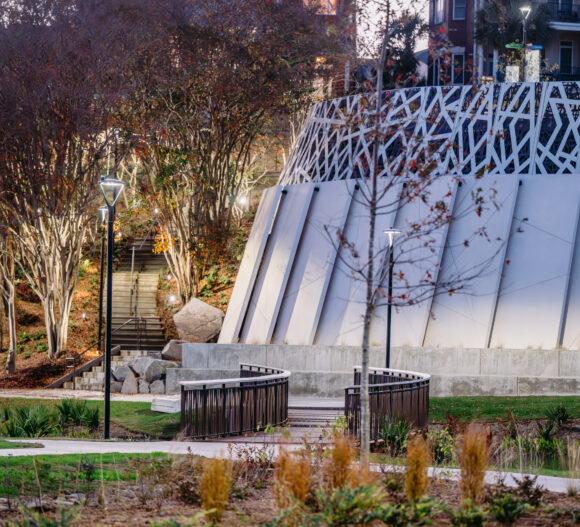
Infrastructure was reimagined as public art. Forty-two overlapping, precast concrete panels (8 feet wide by 17–23 feet tall) transform an existing retaining wall into a glowing “lantern.” Concealed lighting spills from the panel edges after dark, while an up-lit, laser-cut steel framework rises behind to form an overlook guardrail that frames skyline views. Architectural elements throughout the park extend this concept, incorporating warm, lantern-style park buildings that anchor gathering spaces and unify the park’s character.

The landscape is also engineered for durability, allowing for frequent park and community programming without sacrificing turf quality or aesthetics. Adjacent to this core section of the park is a multi-use amenity building, referred to as “the Landing,” which acts as both a piece of park infrastructure and a new iconic landmark. Designed as a lantern-like form, it houses restrooms, concessions, rentals, and shaded gathering areas while reinforcing a visual identity carried throughout the park.

The park is also home to public art in multiple spaces, including rotating sculpture installations and locally inspired murals. Future plans include interactive art elements that connect visitors to local history and storytelling.

Design Success Comes To Life

During planning and construction, the public was skeptical about safety. Few stakeholders could visualize the completed park, and doubt was widespread. That skepticism shifted rapidly after opening. Community response—visible through daily use, social media engagement, and event attendance—revealed how profoundly a neglected public space can weigh on community morale, and how quickly that weight can be lifted when design comes to life and is successful.

Finlay Park’s redesign is a reflection of how urban parks are not just passive amenities. They are active civic centers that shape community and foster meaningful in-person connections. For designers, the project stands as a reminder that preservation and innovation don’t have to work against each other. Instead, they can be complementary tools in the ongoing work of placemaking and urban planning.

About the Authors

Todd Martin, PLA, is the City Landscape Architect for the City of Columbia, S. C. A registered landscape architect in the state, he holds a Bachelor of Landscape Architecture and a Bachelor of Science in Agriculture from the University of Georgia. With 20 years of professional experience, his career spans private practice in Charlotte, N.C., international work in Oslo, Norway, and more than a decade of public-sector work with the City of Columbia.

Mark Johnson, FAIA, FASLA, has deep experience designing parks and public spaces that serve local communities. He believes the answer to even the most complex urban situations lies in understanding the dreams of the local community, which, when turned into design, create places that support community growth and spirit.

Jenny Horne, ASLA, has a passion for preserving, restoring, and renovating natural landscapes and parks, especially throughout the Charleston community and Southeast region. With more than 20 years of experience, she works to create inspired landscapes that reflect context and user needs. Consistently, she helps clients achieve their unique project goals for the design, organization, and use of space. As a landscape architect, she’s accustomed to working with various stakeholder groups in the planning stages of design, including governmental agencies regarding procurement, policies, regulatory issues, and permitting. Horne has won numerous awards from various planning and engineering organizations, including an Honor award for analysis and planning at Finlay Park from the American Society of Landscape Architects and an Engineering Excellence award from the American Council of Engineering Companies for the Hutchinson Square master plan.